
Showing posts with label disney. Show all posts
Showing posts with label disney. Show all posts
Thursday, October 27, 2016
The Lion Guard - Timon and Pumbaa - Bunga's Uncles
Timon and Pumbaa are back in Disney Junior's newest addition to the Lion King universe: The Lion Guard. They are still a part of Simba's family, and have adopted a new kid; a honey badger named Bunga. I can't say this show is particularly... of substance, but it's nice to see the Lion King's "two uncles" are still together and going strong.

Wednesday, June 8, 2016
Zootopia's Judy Hopps Reblog
An article I've been working on just went up today over at the Animation World Network. It was so wonderful working with Dan Sarto again. He really helped narrow my idea, and I'm so pleased with how it turned out. Check it out HERE. The article is about gender in animation, and looking at what makes the primary protagonist in Zootopia so unique.


Tuesday, March 29, 2016
Disney Gender All Theatrical Animation
All American animated theatrically
released Disney films (released under Pixar Animation Studios, DisneyToon
Studios, ImageMovers Digital, Skellington Productions, Walt Disney Animation,
Walt Disney Television Animation), excluding films that included live action, straight
to video films that had a single theater or international premier only, shorts,
Disney package films, and films not produced by Disney but distributed under
the Disney label.
All Gender 1993-2012
This study looks at the gender break down of primary protagonists in family-targeting American animated films from 1993-2012. Including all G or PG-rated American (or American co-produced) animated theatrical releases that were released to at least 500 theaters and were primarily animated (there could be live action scenes, but focus was on animated characters in an animated world). Excluding package films.
151 films (percents rounded)
4 male and female co-protagonists (3%)
23 female primary protagonists (15%)
124 male primary protagonists (82%)
151 films (percents rounded)
4 male and female co-protagonists (3%)
23 female primary protagonists (15%)
124 male primary protagonists (82%)
Thursday, February 18, 2016
Male Duo: Jumba and Pleakley (part the second)

Double Coding
It might seem like I am tossing in a ton of examples in the following, but I actually had to cut down to make this readable. These are some of the more prominent examples. Check out part one for some video examples.
Pleakley-
 The franchise has consistently shown that Pleakley likes dressing as a woman not just because it is a part of his disguise, and that he has insecurities over this (particularly at the start of the franchise). He clearly think that this might not be considered socially acceptable behavior for an earth male, it seems not to be for his species (Season 1, Episode 14). He will quickly justify his love of female clothing by reminding everyone that it is for his disguise.
For example, in Season 1, Episode 22 Pleakley wanders into a conversation that Lilo, Jumba and Stitch are having about one of the recent experiment cousins they are trying to find.
Pleakley is holding a pair of long dangling earrings.
"I can’t get these earrings to stay on. Has anyone seen the duct tape?" He asks.
Lilo, Jumba and Stitch all realize at the same time that because Pleakley has no ears, he will be perfect to help them catch the cousin. They all simply stare at Pleakley in silence. He becomes nervous about this, assuming the silence is them being judgmental about his want to wear earrings.
"What? I’m going to the store. It’s my disguise, remember?"
 In Stitch! The Movie, Pleakley gets caught on the phone with the New You Wonder Girdle Company. (girdles are marketed as shapeware for women in the U.S, and the name winks at older audiences with it's reference to Wonderbra). Pleakley becomes flustered and unconvincingly denies having ordered a girdle (since it's an undergarment for women... why would he need that for his disguise). This movie also shows a conversation between Nani and David, in which Nani confides that she believes Pleakley has been secretly trying on her clothing (he has).
Pleakley is presented as effeminate in a way that can easily be read as queer, similar to the "sissy*" coded characters that have shown up since early Hollywood days (Who's a Sissy? homosexuality according to Tinseltown). *But thankfully Pleakley is not considered a joke because of his nature, jokes tend to have the punchline about his enthusiastic misunderstandings of human culture. He is also into fashion and in an alternate timeline episode is shown as being a very flamboyant world famous fashion designer (Season 2, Episode 6).
 |
| Pleakley sitting on Gantu's lap, throwing shade. |
In Season 1, Episode 25, Nani, Lilo's older sister and guardian, is applying to a job at a rental supply shop. She ends up hosting her potential boss, Jameson, for dinner in order to show her aloha hospitality. The cousin of the episode is Nosy, a gossip who likes to tell everyone's secrets.
 |
| Trend setting Pleakley serving Bulletproof Coffee, before it was even invented. |
Keoni, Jameson's son, talks to Lilo about Pleakley not being a woman, and then shrugs the whole thing off as not a big deal. However Pleakley personally identifies within the show, Keoni and his father would be left to naturally conclude that Pleakley is trans (or somewhere on the spectrum) and is in a relationship with Jumba, and everyone is fine with this.
Jumba-
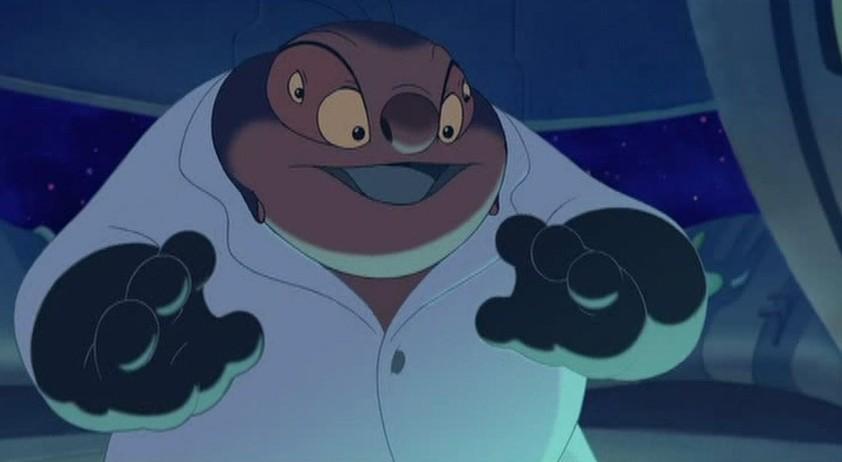
Jumba is more emotionally distant then Pleakley. Unlike Pleakley he has female love interests mentioned (well, two). He had a wife he divorced at some point before the franchise started. In an alternate timeline episode he mentioned having made himself a robot wife (Season 1, Episode 34), but this is also the timeline in which something terrible happened to Pleakley that Jumba won't talk about. Alternate timeline Jumba gives regular Jumba the advice to never built a robot wife, so presumably this doesn't ever happen in the real timeline.
 |
| Jumba and Pleakley's room (Jumba has top bunk) |
Jumba takes pride in being an evil genius and, particularly at the start of the series, this can cause tension in his friendship with Pleakley.
Jumba and Pleakley-
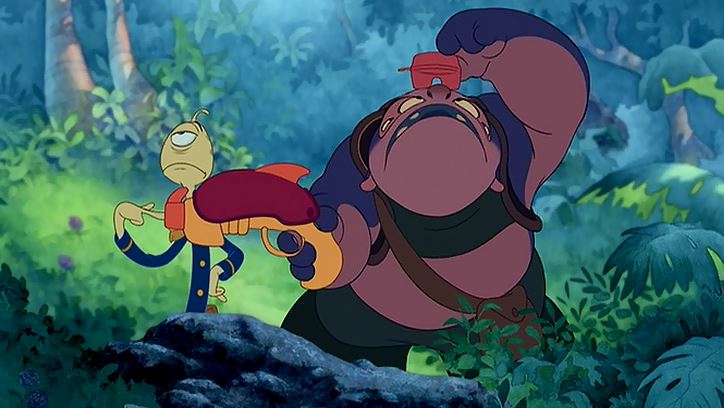
In the first film they are forced together, and share a mutual dislike, bound together by circumstance. Their overarching character development though the franchise is about their friendship, and building of an ohana (together).
In Season 1, Episode 14 we are introduced to Pleakley's family.
Lilo is woken up by Pleakley's phone going off in the middle of the night. Jumba explains that it is Pleakley's mother calling to try and pressure her son to find a wife.
Lilo is surprised, “A wife? Like a lady to marry?”


Pleakley replies, “No.No. No. There will be no wife. NO LADY. And no marrying.” 'No lady' is said at a louder volume, and Pleakley pulls off his sleeping mask to
emphasize this line, before snapping it back on and saying 'no marrying', in a
less angry tone. “My earth studies are my life. I don’t have time for a
relationship.”
This entire episode reads, to use the fandom term, very slashy. But it is exchanges like this which are very interesting. Pleakley's emphasis on not wanting to marry a lady, and specifying the gender neutral "relationship" does give nods to a queer reading of this episode. This episode makes it clear that Pleakley's family wants him to always present male, and marry a woman. He doesn't want to.
Pleakley lies to his mother about already being engaged, and so his whole family shows up. He and Nani have a short lived fake engagement for his families sake, but when Nani finds out that their marriage will be legal, and that their vows would be eternal and galactically binding she bows out. Jumba takes her place, dressed as a woman. The marriage ceremony is interrupted just before they are pronounced man and (wife). Instead of being glad that he was saved from a legally binding marriage, Jumba yells, "You are interrupting climax of earth ceremony."

Leroy and Stitch concludes the series, tying up loose ends and finishing characters arcs. All of the cousins have been found, and in reward the Galactic Council gives Jumba back the key to his evil lab, and Pleakley is granted a position at a galactic community collage as a professor in Earth research. Lilo realizes that it would be selfish to ask her friends to continue to live with her family, and so she encourages them to pursue their dreams.So, Jumba, Pleakley, and Stitch all leave earth.
 Back at his evil lab, Jumba creates an exploding saliva solution, and excitedly calls out to Pleakley to show him, only to remember that Pleakley isn't there. He then puts on a record (that Lilo gave him), that plays "I'm So Lonely I Could Cry" by Elvis Presley. A sad a montage of all the characters being lonely follows.
Later it cuts to Pleakley in his new office. He has two things on this desk, a framed photo of Jumba, and an earth rock that Lilo gifted him. Pleakley calls Jumba, bursting out with how much he misses him, and how he wants to see him. Jumba is pleased that Pleakley called, but doesn't want to continue the conversation because the evil Hamsterviel is in his lab. We then get this exchange:
Pleakley: "But don't you miss your Aunt Pleakley?"
Jumba (under duress from Hamsterviel, to hang up): "No."
Pleakley: "I'm wearing the wig."
Jumba: "No. Not coming back. Never coming back. Never wanting seeing you again."
Pleakley: "Yeah? Well, me neither. What I mean when I said: I miss you so much, can I visit? Was: I don't miss you at all, and I never ever wanna see you ever again, either."
Pleakley hangs up the phone and begins crying hysterically. Jumba is equally upset that Hamsterviel forced him to hurt Pleakley.
After apparently crying it out, the next thing Pleakley does is to fly to Jumba's lab. Unfortunately he shows up mid epic battle between Stitch and the baddies (which results in all the good guys being captured). Pleakley explains to Jumba that he just wanted to make up. To which Jumba affectionately replies, "Next time send flowers."

The movie ends with Jumba and Pleakley choosing each other as their ohana, and deciding to go back to Earth with Lilo and Stitch.
 As I mentioned in part 1, there is no way to guarantee what the intent was by the creators behind all the elements of the franchise. Still, it seems unlikely that the consistent characterization of Jumba and Pleakley's relationship could have been written so carefully with no one involved realizing the possibility of a gay reading (particularly since so many jokes seem to rely on this second reading of the characters). To quote my favorite line of Provenzano when he described this type of ambiguity in Ren and Stimpy (Advocate, 1994, pg 56-58), Pleakley and Jumba are at the very least "Not NOT gay."
1)"Evidence for Fibber" and "Stitch! The Movie Evidence" by justbeus, 2003.
Both these essays were helpful while researching double coding in the series, unfortunately they appear to no longer be available anywhere online.
Wednesday, February 17, 2016
Male Duo: Jumba and Pleakley (part the first)


The Franchise
 The Lilo and Stitch
franchise started with the original theatrical film in 2002, followed by a
straight to video movie a year later: Stitch! The Movie. This launched the series (2003-2006) and
two more straight to video movies - Lilo
and Stitch 2: Stitch has a Glitch (2005), which was written as a direct sequel
to the original film, and Leroy and
Stitch (2006) which concluded the series. (A Japanese spin-off series, Stitch! began in 2008, but for this post
I will be focusing on the American franchise.)
The franchise has been a money maker for the company. At the time of the original films release, Hasbro, which held the master toy license, spoke of how for the first time ever Disney had promised a direct to video sequel before the original film aired (Anne Sherber – Billboard, March 2, 2002) . Sweetening the deal for the company investing in products.
On September third, Lilo and Stitch: The Series aired to much fanfare. In its first month and a half it helped raise Disney’s viewership in children 6-11 62% compared to the year prior. And was “First place among all Monday-through-Friday kids series in key season-to-date ratings.” (Television Week 11/3/2003 Vol. 22 Issue 44, p29).
The title characters, particularly Stitch, have products a plenty, and are the focus of the franchise. In many ways, this allowed the supporting characters of Jumba and Pleakley to fly under the radar.
Male Duo
Jumba is an evil genius who created Stitch, and many other experimental beings. The Brains of the duo, Jumba is: logical, ambitious, more prone to corruption, smart, and a problem solver. He was also married (and divorced) sometime long before the first movie. Pleakley is the Heart: emotional, artistic, loyal, loving. And he isn't only more likely to portray himself as a female; he spends the majority of the series disguised as Lilo’s Aunt (and wife to Jumba).
Jumba and Pleakley check off a lot of boxes for the traditional animated companion male duo, but unlike most of their nineties counterparts, they are not the primary protagonists of the franchise they come from. Much like Timon and Pumbaa in the Lion King, Jumba and Pleakley are comedic sidekick characters that support the main cast. But, while Timon and Pumbaa were the stars of their tv-show spin-off, Jumba and Pleakley remain secondary supporting characters throughout the franchise.
Uniquely, while comedic relief characters are normally added to cartoons for the benefit of keeping a child’s interest, in this case Jumba and Pleakley delivered many of the campy lines that winked at the older audience.
Uniquely, while comedic relief characters are normally added to cartoons for the benefit of keeping a child’s interest, in this case Jumba and Pleakley delivered many of the campy lines that winked at the older audience.
“…The notion that media texts are split into different meanings for different audiences, where irony and camp are strategically used to “conceal” meanings from the mainstream, has been noted as an important part of audience identification in gay communities.” (Kids Rule Nickelodeon and Consumer Citizenship Sarah Banet-Weiser pg. 189).
Linear Reality
Unlike other prominent male duos, like Ren and Stimpy, Jumba and Pleakley exist in a linear reality. Things that happen in one episode affect the episodes to come. For instance, one of the shows reoccurring antagonists, Gantu, has repeatedly torn the roof off the home all the character's live in. In response, Jumba builds a hinged roof system (Season 2, Episode 4), so at the very least they won't need to do massive home repairs every time Gantu decides to attack them. While there isn't much of an overarching story for the seasons, each episode introduces a new cousin that Lilo and Stitch (with the help of Pleakley and Jumba) must catch. These cousins are recurring characters and are remembered from one episode to the next.

Because of the linear reality, consistent characterization holds a different weight for the characters. When certain characteristics are repeatedly enforced, and developed over the course of episodes it's hard to believe that the creators were unaware of the second reading they were creating.
It is worth noting that the series was on television before there had ever been an official out character in a child-targeted american mainstream cartoon. Even if there had been a want to write the characters as a couple they could only have been coded as such.
But...
 nothing official has ever been said about Jumba and Pleakley by their creators, so there is no way to guarantee that any of the choices in how the characters are presented are anything more then an untended double reading by viewers. Both Jumba and Pleakley are aliens, so the show plays with the fact that they don't know a lot about human culture and social expectations. Because they are in hiding and their disguise is being Lilo's aunt and uncle, a lot of coded behavior can be hand waved away. Despite the fact that there are many very consistent characterization (that certainly point to a QUILTBAG friendly reading of the characters) there is a safety in how humor is used in the show, so that nothing needs to be taken too seriously.
But, boy is there a lot of consistent characterization. Let's take a look in:
Part 2 - Double Coding
Monday, September 21, 2015
13 Halloween Cartoons with Protagonists of Color
Halloween is one of my favorite holidays, so I'm starting my blogging for the season a little early this year. This is a list of all the Halloween specials I could find that feature a character of color as the primary protagonist. Not included in this list are ensemble shows that might feature a mixed cast of character.

Mostly this special just follows the gang's Halloween. Going shopping, going to the movies, going trick-or-treating, maybe getting kidnapped by a scary old lady who live near the the cemetery .(spoiler: she's actually a nice). The animation isn't consistent, but it's decent enough considering it's Filmation, and I have a soft spot for the city background art.


On Halloween all the monster children become human for the night. One child hates being a monster, and so makes a deal that turns all the children human forever (much to the horror of their monster families). Juniper must help reverse the spell.


Tufflips and Huggle Bunny host this Halloween episode, which features 5 short "spooky" tales with Sanjay and Craig. None of the stories are too scary, and range from a sort of Hansel and Gretel meets the Island of Doctor Moreau, to a short about drinking haunted milk. Also, we may or may not learn the secret identity of Huggle Bunny in this episode.
Preschool-targeting Halloween Specials:


Doc help a little toy ghost learn not to be afraid of the holiday decorations.
Are all of these specials particularly good? No, not all of them. And The Fat Albert Halloween Special and Little Bill are problematic, considering the allegations against creator, Bill Cosby. But there just aren't that many animated Halloween specials with primary protagonists of color, and all the ones I could find were tie-ins to existing TV shows.
If any of you readers have suggestions for cartoons I missed, please comment : )
The Fat Albert Halloween Special (1977)
Mostly this special just follows the gang's Halloween. Going shopping, going to the movies, going trick-or-treating, maybe getting kidnapped by a scary old lady who live near the the cemetery .(spoiler: she's actually a nice). The animation isn't consistent, but it's decent enough considering it's Filmation, and I have a soft spot for the city background art.
The Proud Family A Hero for Halloween (2002)

Penny Proud is transformed into a Super Hero on Halloween, which is good luck for her family, because it turns out their house is haunted by a ghost.
Lilo and Stitch: The Series Spooky (2003)

Lilo and Stitch are ready to celebrate Halloween. Unfortunately, one of Stitch's cousins appears with the ability to become whatever someone is most afraid of. This episode shows us all the character's fears and calls back to the movie: showing Nani's fear of Lilo being taken away by the state and Stitch's fear of water.
American Dragon: Jake Long Halloween Bash (2005)

Jake throws a Halloween party, and despite being told not to, he invites both supernatural creatures and humans. Luckily he is able to save the day even with his dragon chi taken away as punishment for his partying.
The Life and Times of Juniper Lee It's the Great Pumpkin, Juniper Lee (2005)
On Halloween all the monster children become human for the night. One child hates being a monster, and so makes a deal that turns all the children human forever (much to the horror of their monster families). Juniper must help reverse the spell.
Emperor's New School The Ysma That Stole Kuzcoween/Monster Masquerade (2006)
The first story is about Kuzcoween, the Kuzco centered Halloween they celebrate. The second story is about a masquerade ball. Both Kuzco and Kronk want to ask Malina to go with them, but it turns out she has another secret admirer.
Avatar: The Last Airbender: The Puppetmaster (2007)

While not Halloween-themed, this spooky episode was released as a Halloween special. The team stumble upon a village where people are disappearing. They meet a strange old woman, who appears kindly, but is connected to the dark mystery of the village.
Sanjay and Craig: Tufflips' Tales of Terror (2014)

Preschool-targeting Halloween Specials:
Little Bill The Halloween Costume/The Haunted Halloween Party (2000)

Little Bill makes a Halloween Costume, and is scared on Halloween.
Dora The Explorer Boo! (2003)/ Halloween Parade (2011)

In Boo! Dora goes trick-or-treating with Boots. In Halloween Parade Dora helps a monster find a Halloween costume.
Ni Hao, Kai-Lan Ni Hao, Halloween (2008)

Kai-Lan goes trick-or-treating with her friends.
Go, Diego Go Freddie the Fruit Bat Save Halloween (2008)

Freddy the fruit bat helps Diego set up trick-or-treat booths for the animals.
Doc McStuffins Boo-Hoo to You! (2012)

Doc help a little toy ghost learn not to be afraid of the holiday decorations.
Are all of these specials particularly good? No, not all of them. And The Fat Albert Halloween Special and Little Bill are problematic, considering the allegations against creator, Bill Cosby. But there just aren't that many animated Halloween specials with primary protagonists of color, and all the ones I could find were tie-ins to existing TV shows.
If any of you readers have suggestions for cartoons I missed, please comment : )
Tuesday, March 24, 2015
Disney Channel Toon Gender Ratio 1990s
From the start of 1990 to the end of 1999 there were 24 narrative cartoons that aired on Disney. Some of these started before the nineties, and some continued into the 2000s, but all cartoons that aired during this decade are included. Cartoon shows featuring shorts with a rotating cast (Raw Toonage, Mickey Mouse Works, and The Shnookums and Meat Funny Cartoon Show) were not included.
Shows:
Adventures of the Gummi Bears (1985-1991), Duck Tales (1987-1990), The New Adventures of Winnie the Pooh (1988-1991), Chip n' Dale Rescue Rangers (1989-1990), TaleSpin (1990-1991), Darkwing Duck (1991-1992), Goof Troop (1992-1993), The Little Mermaid (1992-1994), Bonkers (1993-1994), Marsupilami (1993), Aladdin (1994-1995), Gargoyles (1994-1997), The Lion King's Timon & Pumbaa (1995-1999), Quack Pack (1996), Mighty Ducks (1996-1997), Jungle Cubs (1996-1998), Disney's Doug (1996-2000), 101 Dalmatians (1997-1998), Nightmare Ned (1997), Recess (1997-2003), Pepper Ann (1997-2002), Hercules (1998-1999), PB&J Otter (1998-2000), The Weekenders (1999-2004),
Ensemble Casts
Adventures of Gummi Bears (4M, 2F)
Tummi (M), Zummi (M), Grammi (F), Gruffi (M), Sunni (F), Cubbi (M)
Duck Tales (4M)
Scrooge McDuck (M), Huey (M), Dewey (M), Louie (M)
Gargoyles (6M, 2F)
Goliath (M l), Elisa Maza (F), Hudson (M), Brooklyn (M), Lexington (M), Broadway (M), Angela (F), Bronx (M)
Quack Pack (4M)
Donald Duck (M), Huey (M), Dewey (M), Louie (M)
Mighty Ducks (4M 2F)
WildWing Flashblade (M l), NoseDive Flashblade (M), Duke L'Orange (M), Mallory McMallerd (F), Tanya Vanderflock (F), Check Hardwing (M),
Jungle Cubs (6M)
Baloo (M l), Bagheera (M), Louie (M), Shere Kahn (M), Kaa (M), Hathi (M)
101 Dalmations (2M, 2F)
Lucky (M l), Cadpig (F), Rolly (M), Spot (F)
Recess (4M, 2F)
T.J. (M l), Spinelli (F), Vince (M), Gretchen (F), Gus (M), Mikey (M)
PB&J Otters (2F, 1M)
Peanut (M), Butter (F), Jelly (F)
Weekenders (2M, 2F)
Tino (M l), Lor (F), Carver (M), Tish (F)
Main Character (Plus Supporting Ensemble)
The New Adventures of Winnie the Pooh (M) (6M, 1F)
Winnie the Pooh (M)
Tigger (M), Piglet (M), Rabbit (M), Eeyore (M), Owl (M), Roo (M), Kanga (F)
TaleSpin (M) (3M, 2F)
Baloo (M)
Kit (M), Rebecca (F), Molly (F), Wildcat (M), Louis (M)
Darkwing Duck (M) (2M, 1F)
Drake Mallard (M)
Gosalyne (F), Launchpad (M), Honker (M)
The Little Mermaid (F) (2M)
Ariel (F)
Sebastian (M), Flounder (M)
Bonkers (M) (1M, 1F)
Bonkers (M)
Miranda Wright (F), Lucky Piquel (M)
Marsupilami (M) (2M)
Marsupilami (M)
Maurice (M), Stewart (M)
Aladdin (M) (1M, 1F)
Aladdin (M)
Jasmine (F), Genie (M)
Disney's Doug (M) (3M, 2F)
Doug (M)
Skeeter (M), Roger (M), Patti (F), Beebe (F), Porkchop (M)
Nightmare Ned (M)
Ned (M)
Pepper Ann (F) (3F, 1M)
Pepper Ann (F)
Nicky (F), Milo (M), Lydia (F), Moose (F)
Hercules (M) (1M, 1F)
Icarus (M), Cassandra (F)
Duo (Plus Supporting Ensemble)
Chip n' Dale Rescue Rangers (2M) (2M, 1F)
Chip (M), Dale (M)
Monterey (M), Gadget (F), Zipper (M)
Goof Troop (2M) (2M, 2F)
Goofy (M), Max (M),
Peter (M), Peg (F), P.J. (M), Pistol (F)
Timon and Pumbaa (2M)
Timon (M), Pumbaa (M)
Out of 68 main characters: 52 M, 16 F
Out of 109 main characters and main supporting characters: 78M, 31F
19 shows had a male lead and male majority (79%), 2 had a female lead and female majority, 1 had a female lead and a male majority, 2 had equal male and female main characters
In all cases where there was a leader in an ensemble cartoon (5), the leader was a male character.
In both of the cartoons that had equal male and female main characters, a male character was the leader.
While ensemble cartoons had an average of 5 characters, there were never more then 2 female characters on an ensemble show.
1/24 shows had at least 3 female main characters including ensembles (Pepper Ann with 4).
14/24 shows had 3 or more male main characters including ensembles
Thursday, September 25, 2014
Cartoon Closet Part 4
Part 4: Female Duos (in theory)
When looking at animated female duos, it is important to look take into account the role of female characters in animation. In 1991, Katha Pollitt wrote an article that helped define a common trope: The Smurfette Principle. In the article Pollitt discusses the tradition of a male cast of cartoon characters having only one female character, who tags along with the boys.
“The message is clear. Boys are the norm, girls the variation;
boys are central, girls peripheral; boys are individuals, girls types. Boys
define the group, its story and its code of values. Girls exist only in
relation to boys.”
Nostalgia Chick has a fabulous video that gives an overview of this phenomenon. As I blog about in more detail HERE, the 80s became a spread of marketing based animated shows. The cartoons also became decidedly gendered, with shows like Transformers for young boys, and My Little Ponies for girls. In the nineties, shows became less product based, and less gendered in their marketing. Cartoon’s became more inclusive for viewers. But as the Nostalgia Chick points out, the result was that in the shows themselves, the majority of protagonists were male. Token female characters would be a part of ensemble casts, but primary female character who carried a show were rare.
Looking at Disney Channel cartoons from 1990-2000 gives a good example of this. 10 out of the 24 shows that aired were ensemble shows with no primary protagonist. Even though these shows had an upward of 8 main characters, and averaged 5 characters per show - no show had more then 2 female main characters.

Of the 24 shows that aired only 2 had female primary protagonist. While 14/24 of the shows had 3 or more male main characters (including ensembles), only 1/24 shows had at least 3 female main characters (including ensembles).
And Disney was leading the pack. It wasn’t until 1998 that Nickelodeon featured a cartoon with a primary protagonist who was female, The Wild Thornberrys. Similarly, 1998 was the year that Cartoon Network first featured a show with primary female protagonists, with an ensemble cast, The Powerpuff Girls.
It’s probably not surprising then, that while on the rare occasion male/female comedy duos appear, female/female comedy duos don’t. Rarely are there enough female characters to make a comedic duo. Even when there are, female characters are more likely to be daughters, love interests, or sisters to a male character. There is little room for female characters to have a female partner and carry a show, the way male duos did in large numbers during the 90s.
What would a Female Duo look like if they followed Male Duo
traditions?
Two of my favorite web comic artists, Lisa Vandenberg and Rebecca Schauer, co-created an animated web
series for a while. It was the first time that I had seen a cartoon that
brought the comedy duo to female characters with all of the traditional comedy duo humor
(including ambiguous/not so ambiguous relationships). Embracing the
hapless idiot and angry friend trope, not only does Nikki and Page embody the best of the “heart” and “brain”
characteristics that define male duo comedy in animation – it rises to the standard
of bizarre wit that Adult Swim has popularized for older viewers.
Watching this cartoon, is like getting the taste of food everyone tells you can’t be cooked. Of course it can, you’re eating it right now, it’s delicious… but when you try to order it out an a restaurant, everyone simple stares at you blankly and tells you “food like that doesn’t exist.”
Nikki and Page is hysterical, and it doesn’t shy away from overtly “female” comedy. Two shorts in a row joke about menstruation, in the kind of gross-out humor one expects from Ren and Stimpy tradition. Jokes like this don’t fly on mainstream adult targeting animation, humor that deal with “womanly” issues must be coached through a male perspective to be considered universal humor.
Vandenburg recently posted on Tumblr, about a cartoon that she and Schauer had pitched to Nickelodeon.
“I saw this in my old folder and
remembered when me and Becca pitched this show about
young lesbian girls who hang out with spoiled snails that have realistic baby
faces to Nickelodeon. They didn’t think it was as funny as we did, though.”

#the world isn’t ready for this kind of greatness
…and though the hashtag is intended with humor, she’s absolutely right. But this is exactly the kind of show
(in genre) that was being made with male characters in the 90s. Shows like Ren and Stimpy capitalized on the humor that came from the ambiguous relationship
of its title characters.
Vandenberg is now working on Sanjay and Craig as a Storyboard Revisionist. This is a male duo show that matches her comedy style. Seeing an artist like her get an opportunity
working for Nickelodeon gives me hope that someday we might see more diverse female
characters in shows that are considered not just for female viewers, but for
everyone. Maybe someday animated female duos will rise to the ranks of Pinky and the Brain, Ren and Stimpy, and Sanjay and Craig.
Part 5: Female Duos (in practice)
Thursday, January 24, 2013
Timeline
This is an ongoing timeline, showing an overview of the events I discuss in the Cartoon Closet series. It is in progress, and I will continue adding more dates and links to it. If you notice something important I'm missing, please comment, so I can add it in : )
Subscribe to:
Posts (Atom)